Standardizing a Brand Transition: Email Signature Generator
Responsibilities • Deliverables • Tools & Tech
Turning an inconsistent communication touchpoint into a scalable brand tool.
During VCP’s transition into the Covetrus brand, employee email signatures varied in structure, formatting, contact information, links, and logo usage. Because the team communicated frequently with veterinary practices and business partners, these inconsistencies affected a highly visible client touchpoint.
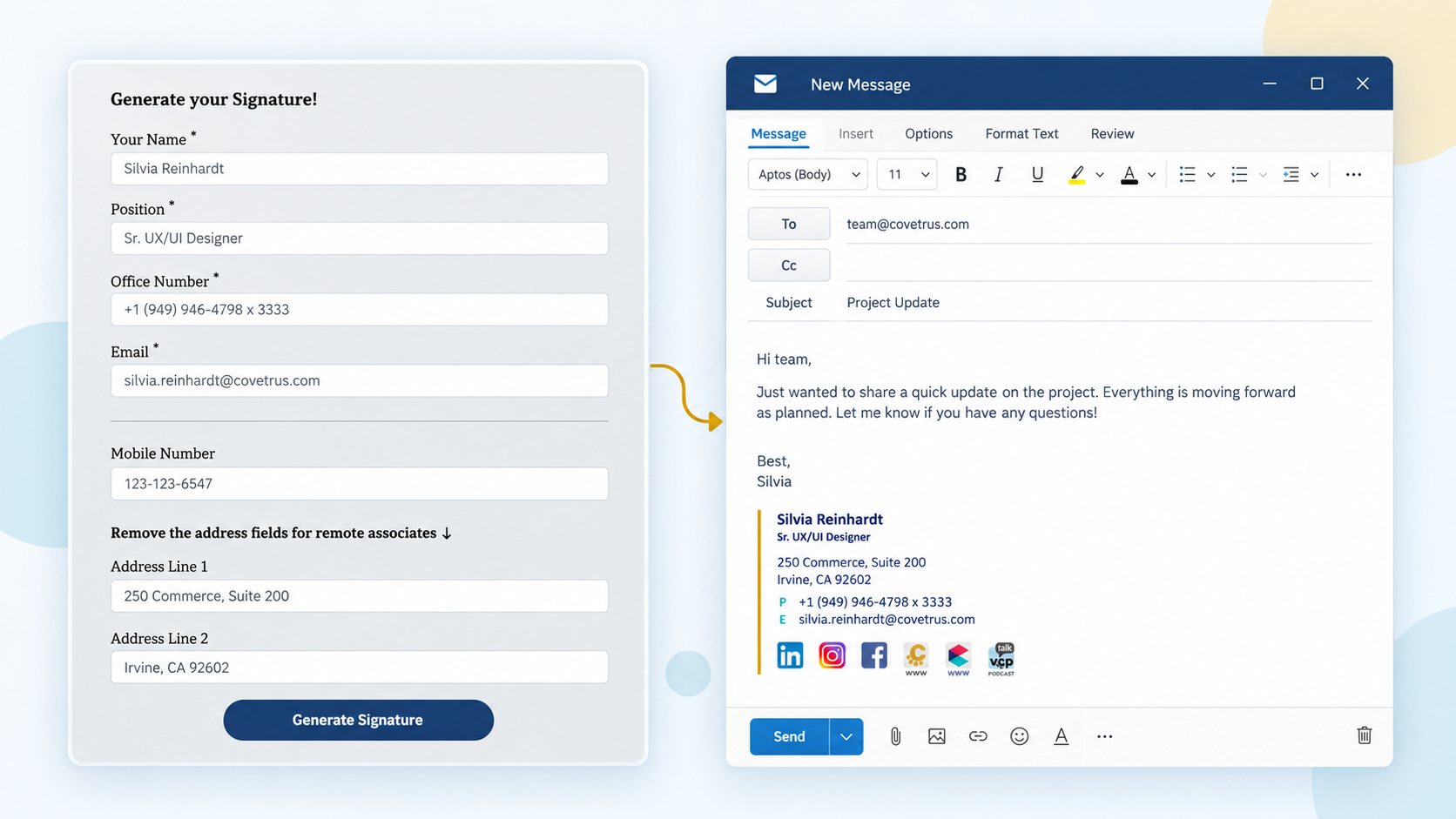
I identified the opportunity, proposed the initiative to the company partner working most closely with branding, and received approval to move forward. I then designed a transitional signature system and built a functional HTML generator that allowed employees to create a standardized signature without requiring individual design or technical support.
1. Context & Opportunity
Following VCP’s acquisition by Covetrus, the company needed to maintain recognition of its established identity while introducing its connection to the new parent brand.
Existing email signatures had been assembled individually, creating inconsistencies in visual hierarchy, formatting, contact details, links, and use of the two identities. Standardizing the signature offered an opportunity to make the transition clearer for clients while simplifying setup for a growing team.
2. My Role
I independently identified and documented the problem, reviewed existing signatures, proposed the initiative, and obtained initial approval from the partner overseeing branding-related efforts. I led the project from discovery through execution, including:
- Auditing existing signature variations and content.
- Defining a clearer information hierarchy.
- Exploring horizontal and vertical layouts.
- Integrating the VCP and Covetrus identities.
- Designing and coding the signature generator.
- Testing the output across multiple email environments.
3. From Audit to Solution
✦ Signature Audit
I reviewed examples used across the company and identified recurring inconsistencies in layout, typography, contact information, image treatment, and links. Some signatures also lacked functional access to company websites and social channels.
✦ Design Exploration
I created horizontal and vertical concepts using both filled and outlined icon styles. The explorations balanced VCP’s established client recognition with the need to introduce Covetrus as the new parent brand.
I also refined the information hierarchy to improve readability and use inbox space more efficiently.
✦ Generator Development
Rather than creating each employee’s signature manually, I designed and coded a self-service HTML generator. Employees could enter their name, role, phone number, email, and office information while viewing the completed signature in a live preview.
Once generated, the signature could be copied and transferred directly into Outlook with its formatting, branding, images, and links already in place.
4. Technical Validation
Email signatures introduce constraints that do not exist in standard web design. Formatting can render differently across applications, and images referenced from an employee’s computer may appear broken for recipients.
To improve reliability, I hosted the image assets on a central server and structured the signature specifically for email-client compatibility. I tested the generated output across Outlook, Gmail, and web-based email environments, validating:
- Layout and formatting.
- Image rendering.
- Contact and social links.
- Copy-and-paste behavior.
- Overall readability and brand consistency.
5. Outcome
The project resulted in a functional, tested prototype that transformed an inconsistent, manually assembled asset into a repeatable self-service workflow.
The proposed system demonstrated how VCP could maintain consistent client communications, reduce setup errors, and support its transition into the Covetrus brand without creating every employee signature individually.
Although the initiative did not advance to a company-wide rollout after internal priorities changed, the completed prototype demonstrates my ability to identify an overlooked organizational need and carry a solution from audit and strategy through visual design, front-end development, and cross-platform validation.